If you've ever wondered how digital marketing can help your business grow in 2026, you're not alone. Business owners face more marketing options than ever — but also more noise, complexity, and wasted budget if they choose wrong. The truth? Digital marketing isn't just helpful — it's now essential for reaching customers, competing effectively, and growing profitably. This guide breaks down exactly how digital marketing helps businesses with real data, proven examples, and practical strategies you can start using today.
💡 What Is Digital Marketing?
Digital marketing is the practice of promoting products, services, or brands through online channels like search engines, social media, email, and websites. Unlike traditional marketing (TV, radio, print), digital marketing is measurable, targetable, and adjustable in real-time — making it dramatically more cost-effective for businesses of all sizes.
🚀 How Digital Marketing Helps Businesses Grow
Here are the core ways digital marketing drives business growth in 2026:
Reaches Your Exact Target Audience
Target by location, age, interests, behavior, and buying intent — ensuring your message reaches people most likely to buy.
Delivers Measurable ROI
Track every dollar spent and every result generated. Email marketing returns $36-$42 per $1 spent. SEO delivers $22 per $1 invested.
Scales With Your Budget
Start with $500/month or $50,000/month — digital adapts to your resources and grows with your business.
Expands Your Market Reach
Go beyond local boundaries. Reach customers globally or hyper-locally — whatever fits your business model.
Generates Immediate Results
Paid ads can drive traffic and leads within 24 hours. SEO builds long-term compound growth.
Builds Customer Relationships
Email, social media, and content marketing nurture prospects into loyal customers and brand advocates.
Real 2026 Data:
For every $1 spent on digital marketing, businesses earn an average of $5 in return — that's a 500% ROI. Meanwhile, 58% of small businesses now rely on digital marketing as their primary customer acquisition channel.
🏢 Digital Marketing Benefits by Business Type
For Startups & New Businesses
- Cost-effective customer acquisition without massive ad budgets
- Fast validation of product-market fit through paid ad testing
- Build brand awareness from zero using content and social media
- Compete with established players through SEO and niche targeting
For Local Service Businesses
- Dominate local search results through Google Business Profile optimization
- Target customers in specific geographic areas with geo-targeted ads
- Generate high-quality leads through local SEO and PPC
- Build reputation through reviews and social proof
For E-commerce Stores
- Drive immediate sales through product ads on Google and Facebook
- Recover abandoned carts with email and retargeting campaigns
- Increase average order value through personalization and upsells
- Build recurring revenue through email marketing and loyalty programs
For B2B Companies
- Generate qualified leads through content marketing and LinkedIn ads
- Establish thought leadership through blogging and speaking
- Nurture long sales cycles with email automation and webinars
- Target decision-makers with precision using LinkedIn and ABM strategies
💼 Real Examples of How Digital Marketing Helps Businesses
Example 1: Local Restaurant
A family-owned restaurant in Austin invested $2,000/month in Google Ads and Instagram ads targeting foodies within 10 miles. Result: 450 new customers in 3 months, $67,500 in revenue from a $6,000 investment — 11x ROI.
Example 2: SaaS Startup
A project management software company allocated $5,000/month to SEO and content marketing. After 6 months, they ranked for 200+ keywords, generated 15,000 monthly organic visitors, and converted 300 trial signups — reducing CAC from $250 to $80.
Example 3: E-commerce Fashion Brand
An online clothing store spent $10,000/month on Facebook and Instagram ads with UGC content. They generated $85,000/month in sales (8.5x ROAS), built a 50,000-person email list, and created a sustainable customer acquisition engine.
Common Pattern: All three examples started with clear goals, focused budgets on 1-2 channels, tracked results obsessively, and scaled what worked. That's the digital marketing formula that drives real business growth.
⏱️ Short-Term vs Long-Term Benefits of Digital Marketing
Short-Term Benefits (0-3 Months)
- Immediate traffic from paid ads (Google, Facebook, LinkedIn)
- Quick lead generation through targeted campaigns
- Fast market validation by testing messaging and offers
- Brand visibility boost through social media and display ads
Long-Term Benefits (6-24+ Months)
- Compounding organic traffic from SEO and content marketing
- Lower customer acquisition costs as brand awareness builds
- Sustainable revenue streams from email lists and loyal customers
- Market authority positioning your brand as the go-to expert
- Competitive moats through owned audiences and SEO rankings
The Strategy: Use paid ads for immediate results while building SEO and content assets that compound over time. This balanced approach delivers growth today while creating sustainable advantages for tomorrow.
See How Digital Marketing Can Help Your Business
Get a free consultation and custom growth plan — no sales pitch, just strategic advice.
Request Your Free Strategy Session →📊 Digital Marketing Channels That Drive the Most Impact
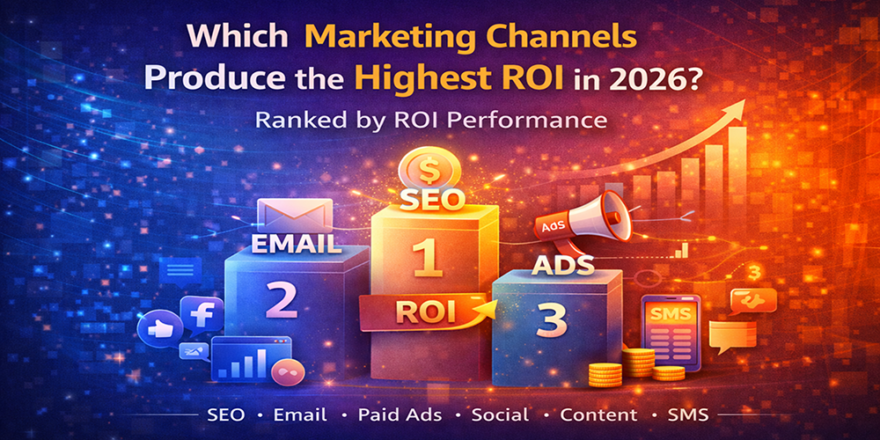
Based on 2026 ROI data, here are the channels delivering the highest returns:
1. Email Marketing — 3,600% to 4,200% ROI
Email delivers $36-$42 for every $1 spent, making it the highest-ROI channel. Use it for nurturing leads, customer retention, and driving repeat purchases.
2. SEO — 2,200% ROI
SEO returns $22 per $1 invested after 6-12 months. It drives sustainable, compound growth and reduces long-term acquisition costs dramatically.
3. Paid Search (Google Ads) — 200% ROI
PPC returns $2 per $1 spent with immediate results. Perfect for high-intent buyers actively searching for your solution.
4. Social Media Ads — Variable (200%-2,000% ROI)
Facebook and Instagram ads vary widely by industry and execution, but well-optimized campaigns consistently deliver 3x-10x ROAS for e-commerce and lead gen businesses.
5. Content Marketing — 300%-500% ROI
Blog posts, videos, and guides build authority, drive organic traffic, and generate leads. ROI compounds over time as content continues ranking and converting.
6. Video Marketing — 900% average ROI
90% of video marketers report excellent ROI. Short-form video (TikTok, Reels, YouTube Shorts) dominates engagement and discovery in 2026.
🚫 Common Myths About Digital Marketing
Myth 1: "Digital marketing is too expensive for small businesses."
Truth: You can start with $500/month and scale based on results. Digital is actually cheaper and more measurable than traditional advertising.
Myth 2: "You need to be on every platform."
Truth: Focus on 1-2 channels where your audience actually spends time. Depth beats breadth.
Myth 3: "Results happen overnight."
Truth: Paid ads deliver fast, but SEO and content take 3-6 months. Balance short-term and long-term strategies.
Myth 4: "Digital marketing is just for online businesses."
Truth: Local businesses, service providers, and brick-and-mortar stores benefit enormously from local SEO, Google Ads, and social media.
Myth 5: "You need to be a tech expert."
Truth: Agencies and freelancers can handle execution. You just need clear goals and the willingness to invest strategically.
🎯 How to Get Started with Digital Marketing
- Define clear goals: More traffic? More leads? More sales? Revenue targets?
- Know your audience: Who are they? Where do they spend time online? What problems do they have?
- Choose 1-2 channels to start: Don't spread thin. Master one channel before adding more.
- Set a realistic budget: Allocate 5-15% of revenue to marketing. Start small and scale what works.
- Create valuable content: Focus on helping your audience, not just selling.
- Track everything: Use Google Analytics, UTM codes, and conversion tracking from day one.
- Test, measure, optimize: Digital marketing is iterative. Improve continuously based on data.
- Scale winners, cut losers: Double down on what delivers ROI. Stop what doesn't.
🤝 When to Hire Professional Digital Marketing Help
Consider hiring an agency or specialist when:
- You're spending $3,000+/month but not seeing clear ROI
- You lack in-house expertise in SEO, PPC, or content strategy
- You're too busy running the business to manage marketing yourself
- You need to scale faster than you can hire and train internally
- You're launching a new product or entering a competitive market
- You want access to premium tools and proven processes without building from scratch
Expected Investment: Professional agencies typically charge $3,000-$15,000/month depending on scope. Freelancers cost $1,000-$5,000/month. Compare this to the $60,000+/year cost of hiring a full-time marketing manager with limited specialization.
✅ Is Digital Marketing Worth It for Your Business?
Short answer: Almost certainly yes.
Digital marketing works best for businesses that:
- Sell to customers who research online before buying (which is nearly everyone in 2026)
- Can track and measure ROI through analytics and conversion data
- Are willing to invest consistently for 3-6 months to see full results
- Have a product or service with positive unit economics (LTV > CAC)
- Want to compete and grow in an increasingly digital marketplace
The Bottom Line:
of small businesses plan to increase their digital marketing spending in 2026. The question isn't whether to invest in digital marketing — it's how to invest smartly to maximize ROI while competitors pull ahead.