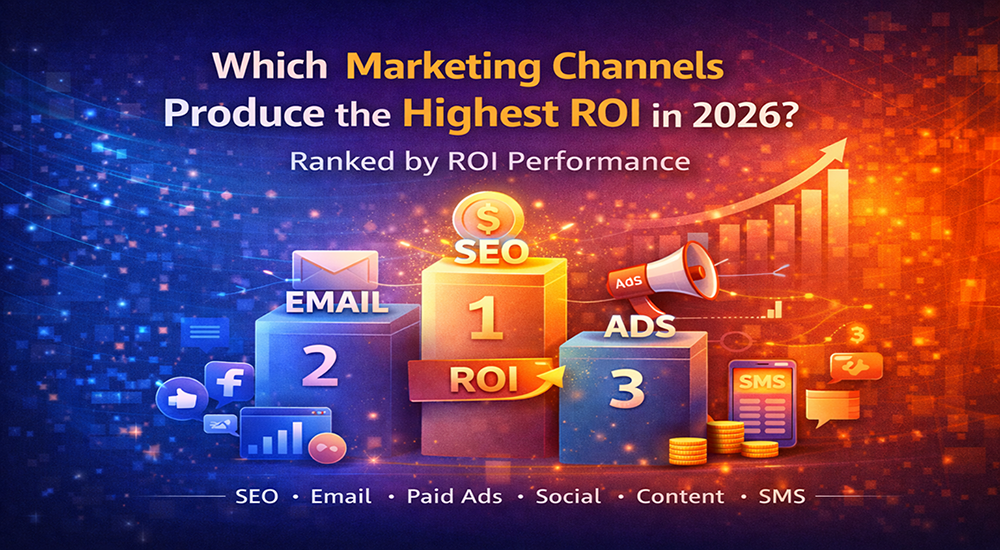
Every marketing dollar matters—especially when CAC is climbing 30–40% annually and budgets are under constant scrutiny. Business owners and CMOs ask the same question: which marketing channels produce the highest ROI so we can allocate spend intelligently? The answer isn't simple, because "highest ROI" depends on your business model, timeline, and goals. But the 2026 data is clear: email marketing leads with 3,600% ROI ($36 per $1 spent), followed by SEO at 2,200% ($22 per $1), and PPC at 200% ($2 per $1). This guide ranks every major channel with real benchmarks, explains why certain channels outperform others, and shows you exactly how to combine them for maximum returns.
💡 What Does ROI Mean in Marketing?
ROI (Return on Investment) measures the revenue generated relative to the amount spent. In marketing, it answers: "For every dollar I invest in this channel, how many dollars do I get back?"
An ROI of 500% means you earn $5 for every $1 spent. An ROI of 200% means $2 per $1. Anything above 100% is profitable—you're making more than you're spending.
Why ROI Matters
- Justifies marketing spend to leadership and investors with concrete financial outcomes
- Prioritizes channel allocation so you invest more in what delivers and cut what doesn't
- Compares across channels to make apples-to-apples decisions about where to focus
- Measures efficiency to scale profitable channels without burning budget
🧮 How Marketing ROI Is Calculated
The basic formula:
ROI = [(Revenue from Marketing − Marketing Cost) ÷ Marketing Cost] × 100
Example Calculation
Let's say you spent $10,000 on an SEO campaign that generated $80,000 in revenue.
- Revenue from marketing: $80,000
- Marketing cost: $10,000
- ROI = [($80,000 − $10,000) ÷ $10,000] × 100 = 700% ROI
This means you earned $7 in net profit for every $1 spent.
What to Include in Marketing Cost
- Ad spend (PPC, social ads, display)
- Agency or freelancer fees
- Internal team salaries (prorated for time on channel)
- Software and tools (email platform, analytics, SEO tools)
- Content production costs (writing, design, video)
💡 Important Note: A "good" ROI depends on industry, business model, and channel. A 5:1 ratio ($5 earned per $1 spent, or 500% ROI) is generally considered strong across digital marketing. Email (3,600%) and SEO (2,200%) exceed this dramatically.
🏆 Top Marketing Channels by ROI in 2026 (Ranked)
Based on 2026 industry data from HubSpot, WebFX, DemandSage, and First Page Sage, here are the highest ROI marketing channels ranked:
| Rank | Channel | Average ROI | $ Return per $1 Spent | Time to ROI |
|---|---|---|---|---|
| 1 | Email Marketing | 3,600% – 4,200% | $36 – $42 | Immediate to 3 months |
| 2 | SEO (Organic Search) | 748% – 2,200% | $7.48 – $22 | 3 – 12 months |
| 3 | Content Marketing | 300% – 500% | $3 – $5 | 3 – 9 months |
| 4 | Influencer Marketing | 578% | $5.78 | 1 – 6 months |
| 5 | Video Marketing | 900% | $9 | 1 – 4 months |
| 6 | Webinars (B2B) | 213% | $2.13 | 1 – 3 months |
| 7 | PPC (Google Ads) | 200% – 800% | $2 – $8 | Immediate to 1 month |
| 8 | Social Media Ads | 150% – 300% | $1.50 – $3 | Immediate to 2 months |
| 9 | Organic Social Media | 95% – 250% | $0.95 – $2.50 | 3 – 12 months |
| 10 | Display Advertising | 100% – 200% | $1 – $2 | Immediate to 1 month |
Email marketing delivers the highest dollar-for-dollar ROI in 2026, returning $36–$42 for every $1 invested. This is why 59% of B2B marketers rate email as their most effective channel for prospecting—more than PPC, SEO, and organic social combined.
🔍 Why These Channels Deliver Higher ROI
Why Email Marketing Has the Highest ROI
- Direct access to your audience without algorithmic filtering or paid reach
- Owned asset that isn't subject to platform policy changes or ad cost inflation
- High personalization and segmentation capabilities drive relevance and conversions
- Low marginal cost to send additional emails once infrastructure is built
- Measurable attribution with clear tracking from send to conversion
Why SEO Delivers Strong Long-Term ROI
- Compounding returns as rankings strengthen and content continues attracting traffic years later
- No ongoing cost per click unlike paid advertising
- Captures high-intent buyers actively searching for solutions
- Builds brand authority that generates trust and repeat traffic
- Organic traffic drives 40%+ of revenue for most businesses
Why PPC & Paid Ads Have Lower (But Faster) ROI
- Immediate results but traffic stops when budget ends
- Rising CPCs due to increased competition on Google and Meta
- No compounding effect—returns are linear with spend
- Still valuable for quick wins, testing, and targeting specific audiences
⚖️ ROI Comparison: Organic vs Paid Channels
| Factor | Organic Channels (SEO, Content, Organic Social) | Paid Channels (PPC, Social Ads, Display) |
|---|---|---|
| Average ROI | 500% – 2,200% | 150% – 800% |
| Time to ROI | 3 – 12 months | Immediate – 1 month |
| Longevity | Compounds indefinitely | Stops when budget ends |
| Upfront Investment | High (content, technical work) | Low to moderate |
| Scalability | Slow to scale initially | Instantly scalable with budget |
The Optimal Mix for 2026
The data shows successful businesses allocate 60% to organic channels (SEO, email, content) and 40% to paid channels (PPC, social ads). This balanced approach:
- Builds long-term assets through organic efforts that appreciate over time
- Delivers immediate traffic and conversions through paid channels while organic matures
- Reduces platform dependency by diversifying sources
- Provides budget flexibility to scale paid up or down based on performance
💼 Highest ROI Channels by Business Type (B2B vs B2C)
B2B Highest ROI Channels (2026 Data)
- Website, Blog & SEO: #1 ROI driver for B2B (HubSpot 2025)
- Email Marketing: 261% ROI, with 59% of B2B marketers rating it most effective for prospecting
- Webinars: 213% ROI, ideal for educating and qualifying enterprise buyers
- Paid Social (LinkedIn): Strong for account-based marketing and targeting decision-makers
- PPC: 36% ROI but 4-month break-even makes it attractive for quick pipeline
B2C Highest ROI Channels (2026 Data)
- Email Marketing: #1 ROI driver for B2C, especially in retail/e-commerce (4,500% ROI)
- Paid Social Media: Facebook and Instagram ads excel for direct-to-consumer brands
- Content Marketing: Builds brand affinity and drives organic discovery
- Influencer Marketing: High ROI (578%) for fashion, beauty, lifestyle verticals
- Short-Form Video (TikTok, Reels): 30%+ ROI and massive reach for younger demographics
Key Takeaway: B2B favors longer-cycle, education-heavy channels (SEO, webinars, LinkedIn). B2C prioritizes emotional triggers, social proof, and direct-response channels (email, paid social, influencers). Both agree email delivers exceptional ROI.
⏱️ Short-Term ROI vs Long-Term ROI Channels
Best Channels for Short-Term ROI (0–3 Months)
- PPC (Google Ads): Drive traffic and conversions within 24–48 hours
- Social Media Ads: Launch campaigns and see results in days
- Email to Existing List: Send a campaign and generate sales immediately
- Retargeting Ads: Re-engage warm audiences with high conversion rates
Best Channels for Long-Term ROI (6–24+ Months)
- SEO: Rankings compound over time, delivering 748%–2,200% ROI after 12+ months
- Content Marketing: Blog posts and videos continue driving traffic for years
- Email List Building: Growing an owned audience that generates returns indefinitely
- Brand Building via Organic Social: Slow but creates lasting customer loyalty
The Strategy: Use short-term channels to generate revenue today while investing in long-term channels that will reduce CAC and increase LTV over time. Early-stage businesses might skew 60/40 paid to get traction. Mature businesses shift to 70/30 organic once systems are established.
Get a Free ROI Marketing Assessment
See which channels will deliver the highest ROI for your specific business model, stage, and goals—completely free.
Request Your Free Assessment →🔗 How to Combine Marketing Channels for Maximum ROI
The highest-performing strategies don't rely on a single channel—they orchestrate multiple channels that reinforce each other:
The High-ROI Channel Stack
Foundation Layer (60% of budget):
- Email marketing for owned audience nurture and retention
- SEO for long-term organic traffic and authority building
- Content marketing supporting both email and SEO
Growth Layer (30% of budget):
- PPC for immediate qualified traffic while SEO builds
- Social media ads for retargeting website visitors and expanding reach
- Video marketing for engagement and brand storytelling
Experimental Layer (10% of budget):
- Test new channels (TikTok, podcasts, influencer partnerships)
- Try emerging tactics (AI-powered personalization, interactive content)
- Validate assumptions before scaling investment
Example: E-Commerce Store Multi-Channel Strategy
- Email (40%): Abandoned cart sequences, post-purchase upsells, win-back campaigns
- PPC (25%): Google Shopping and search ads for high-intent product keywords
- Social Ads (20%): Facebook/Instagram retargeting and lookalike audiences
- SEO (10%): Product pages and buying guides targeting long-tail keywords
- Influencer (5%): Partnerships with micro-influencers for social proof
This mix delivers immediate sales (PPC + Social) while building long-term assets (email list + SEO) and leveraging social proof (influencers).
⚠️ Common ROI Measurement Mistakes
- Using last-click attribution only. This over-credits the final touchpoint and ignores the contribution of awareness and consideration channels. Use multi-touch attribution when possible.
- Not accounting for full marketing costs. Forgetting to include salaries, tools, and overhead understates true cost and inflates ROI artificially.
- Comparing channels on different timelines. SEO takes 6–12 months to mature. Judging it against PPC's 30-day results is unfair. Compare apples to apples.
- Ignoring customer lifetime value (LTV). A channel with low immediate ROI might attract higher-LTV customers. Factor in retention and repeat purchases.
- Not segmenting by business type. B2B and B2C have different conversion cycles and channel effectiveness. Industry benchmarks matter.
- Stopping measurement too early. Many channels (SEO, content, email list building) show their true value 6–12 months in. Don't kill them prematurely.
📈 How to Improve ROI in Any Marketing Channel
Universal ROI Improvement Strategies
- Improve targeting precision. The more relevant your message to the audience, the higher your conversion rate—directly boosting ROI.
- Optimize for conversions, not just traffic. A 10% conversion rate improvement doubles ROI if costs stay constant.
- Reduce cost through efficiency. Automate manual tasks, negotiate better rates, use in-house vs agency where it makes sense.
- Increase customer LTV. Focus on retention, upsells, and referrals to make each acquired customer more valuable.
- Test and iterate constantly. A/B test everything—headlines, CTAs, landing pages, ad creative, email subject lines.
- Kill underperformers quickly. Cut campaigns or channels that consistently deliver below breakeven. Reallocate to winners.
- Scale what works systematically. When a channel delivers 3:1+ ROI consistently, double down before market saturation.
Channel-Specific Quick Wins
Email: Segment lists by behavior and personalize subject lines (37% higher CTR)
SEO: Target long-tail keywords with lower competition and higher buyer intent
PPC: Use exact and phrase match over broad match to reduce wasted spend
Social Ads: Retarget website visitors who didn't convert (10x higher conversion rates)
Content: Update and republish high-performing old posts to recapture rankings